
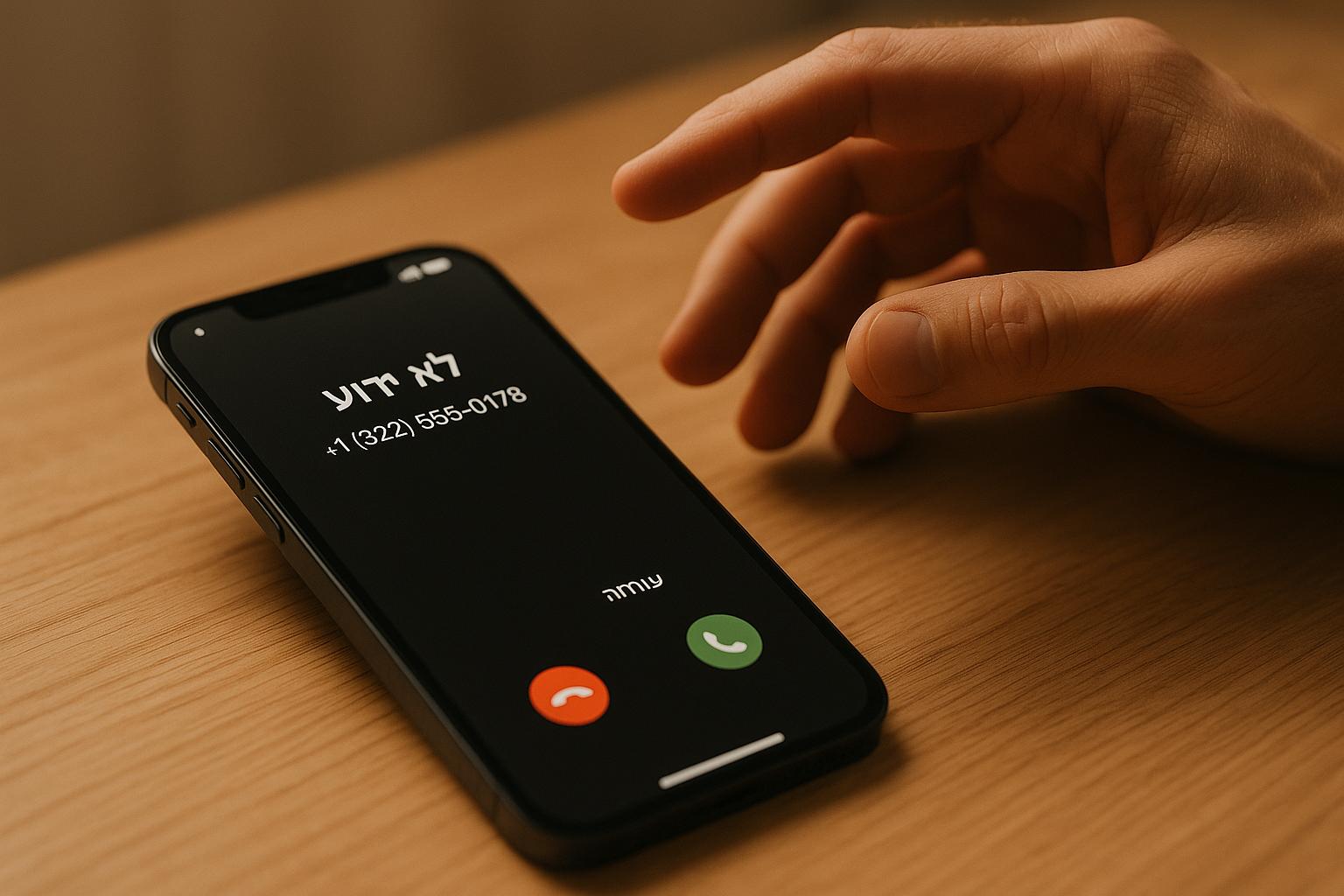
Frequently Asked Questions about Call Identification
How to protect yourselves from unidentified calls and phone scams?
In Israel, unidentified calls have become a real threat to our privacy and money. Almost half of Israelis (42%) have fallen victim to financial scams or phishing attacks. However, there are tools and tips that can help you avoid harm:
Call identification technologies: Apps like Traceback identify suspicious numbers in real-time and provide information about callers.
Blocking unwanted calls: Both Android devices and iOS allow manual and automatic blocking of unidentified numbers.
Additional tools: Google search, using social networks, and community reporting sites can help identify callers.
Maintaining privacy: Check app permissions, update your operating system, and avoid sharing personal information.
What to do if you receive a suspicious call?
Do not rush to answer.
Document the call details (number, time, content).
Report to authorities such as the police, the National Cyber Directorate, or the Supervisor of Banks.
Proper use of tools and technologies will protect you from dangerous calls and prevent unnecessary damage.
The Russian Sting: Phone Scams We All Need to Know About
How Call Identification Technology Works
When a call is received, the network transmits the caller's number along with the call itself. However, technical limitations and compatibility issues can cause this information to not always be accurate – and sometimes it simply doesn't appear.
In Israel, the display of caller ID for local calls is defined as "not guaranteed" by telecom providers. Incoming international calls often suffer from this problem as well. Furthermore, there are additional reasons why the caller ID is not displayed, as explained below.
Why Some Calls Appear as 'Unknown Caller ID'
There are several main reasons for this phenomenon. One is partial information transfer between telecom networks, especially in international calls or in cases where telecom providers are not technically compatible with each other.
In addition, some callers deliberately choose to hide their number. This can be done by dialing a special code before the number or through phone privacy settings. While there are cases where hiding is justified, it is often an attempt to circumvent identification – for less transparent reasons.
Israeli Telecom Provider Systems
Beyond technical limitations, Israeli telecom providers also face additional regulatory and technological challenges regarding call identification. Not all providers support call identification app services at the same level, which can lead to significant gaps in user experience.
For example, call identification services are not always available from providers such as Golan, 018, and Partner. In contrast, providers like Cellcom, Pelephone, Wecom, and Hot Mobile offer support, but sometimes a complex manual setup is required.
Differences in protocols and technical limitations of each network make it difficult to create a unified solution for call identification. Although some improvement has been made in this area, challenges still exist, and the path to full support across all networks is still long.
Caller ID Type | Incoming Calls (PSTN to Twilio) | Outgoing Calls (Twilio to PSTN) |
|---|---|---|
Local (within Israel) | +E.164 Format | Local (Not Guaranteed) |
This table illustrates the lack of uniformity in call identification in Israel. Even local calls do not always display a reliable caller ID, which explains why so many calls arrive without any information about the caller.
How to Identify Unknown Callers
When you receive a call from an unknown number, do not rush to answer. Instead, there are several simple and effective ways to check who is behind the call and avoid scams or harassing calls. Here are some tips to help you deal with such situations.
Google search is an initial and easy way to start. Simply type the number in quotation marks into the search engine, and you will see if any information is available. Sometimes you will find reports from other people or discover that the number belongs to a certain business. However, this method does not always yield results, especially when dealing with new or private numbers.
Call Identification Apps
Call identification apps offer a more advanced solution. They use extensive databases and user reports to identify who is calling, even before you answer.
Traceback, for example, is a popular Israeli app that allows identifying calls from hidden numbers. It is available for iOS and Android devices and supports all communication providers in Israel. The app provides real-time identification of calls from unknown numbers, detailed call history, and even notifications for missed calls.
Prices: 13₪ per week, 22.90₪ per month, or 225₪ per year. Traceback emphasizes privacy and also allows users to export reports.
The prominent advantage of such apps is their ability to work in real-time. The moment a call is received, the app compares the number to its database and displays information about the caller – whether it's a business, a government entity, or a number reported as suspicious.
Additional Methods for Number Identification
Beyond apps, there are a few other ways to find out who is calling.
Social networks: Sometimes a quick search for the number on Facebook or other networks can provide an immediate answer.
Community reporting sites: On such sites, users share experiences and reports about suspicious numbers. If the number is harassing many people, you are likely to find detailed information about it.
Contacting the communication provider: Some telecom providers in Israel offer basic identification services or can provide information about suspicious numbers in special cases.
If you receive repeated calls from a number that does not leave a voicemail or SMS, this may be a warning sign. Reliable callers will usually leave a message if it is an important matter.
Combining several methods is the best way to get a clearer picture. Use Google, apps, and community reporting sites together to understand who is trying to contact you. This combined approach will give you the tools to decide whether to answer or ignore.
How to Block Unwanted Calls
After learning how to identify unknown callers, the next step is to understand how to block harassing calls. Both Android devices and iPhones offer built-in options for this, and there are also apps that provide an additional layer of protection.
Blocking Calls on Android Devices and iOS

On iPhones, you can enable the "Silence Unknown Callers" feature via: "Settings → Phone → Silence Unknown Callers". This feature automatically sends calls from numbers not in your contacts list to voicemail. The calls will still appear in your Recent Calls list, so you can track them if you wish.
If you prefer to block numbers manually, simply go to Recents, tap the "i" next to the desired number, and choose the "Block this Caller" option. To manage your list of blocked numbers, go to "Settings → Phone → Blocked Contacts" where you can add or remove numbers as needed.
On Android, the process is similar – long-press the number in the call log and select the "Block" option. Some Android devices also offer advanced options, such as automatically blocking unidentified numbers.
Note: Operating system updates are very important. They not only improve performance but also include fixes that help filter spam calls more effectively.
Using Call Identification and Filtering Apps
Call identification apps are an excellent aid for preventing unwanted calls. For example, the Traceback app identifies suspicious calls in real-time, based on updated data and user reports. This allows you to make an informed decision whether to block the number or not.
To ensure that such apps function optimally, they must be configured correctly. On iPhone, go to "Settings → Phone → Call Blocking & Identification" and enable the apps you wish to use. This action will grant them permission to identify and block suspicious calls.
Combining built-in device tools with specialized apps will provide you with a more comprehensive layer of protection against harassing calls.
Privacy and Data Security
In addition to guidelines for blocking calls, it is important to understand how to protect your personal information. While call identification apps provide a useful service, they require access to sensitive information. Therefore, it is important to be aware of how they process data and to take simple steps to maintain privacy.
How Apps Handle Your Information
Call identification apps sometimes collect details such as contact lists, call history, and even your location information. Before installing a new app, it is advisable to check what data it requests access to.
For example, the Traceback app focuses on collecting identification information only, ensuring that data is transmitted in an encrypted and secure manner. Other quality apps include a detailed privacy policy, which explains exactly how they use your information. It is important to read the policy carefully, and if anything seems unclear or concerning, consider looking for an alternative.
Protecting Your Personal Information
In Israel, the Privacy Protection Law, 5741-1981, underwent significant updates (Amendment No. 13, 5774-2024) which will come into effect in August 2025. The Privacy Protection Authority operates to supervise the management of digital personal information. However, the responsibility for protecting information begins with you.
Check permissions: Ensure that apps only receive access to the data they need. On iPhone, go to "Settings → Privacy & Security" and check what data is accessible to each app. On Android, you can check this in "Settings → Apps → Permissions".
Update software regularly: Regular updates for your apps and operating system close potential security vulnerabilities.
Change sharing settings: Some apps share information with third parties. If you are not satisfied with this, adjust the settings or choose another app that better suits your needs.
Remember that your information is yours alone. Demand full transparency and strict protection in every app you use.
Reporting Scam Calls to Authorities
If you identified a suspicious call and managed to prevent harm, the next step is to report it to the relevant authorities. This is an important action that can help not only you but also others, by preventing similar incidents in the future. In Israel, several authorities handle complaints about scam calls, each focusing on different areas. Here is a guide to help you document and report systematically.
Submitting Reports to Relevant Authorities
Police and Ministry of Public Security: If you received a call where someone impersonated a police officer or another government entity, contact the police via hotline 100 or the official website. The police primarily handle cases of financial damage or identity theft.
National Cyber Directorate: If the suspicious call is related to cyber threats, you can contact the Cyber Emergency Team at 119 or by email 119@cyber.gov.il. The Directorate focuses on protecting the civilian sector from cyber incidents, including those that start with scam calls.
Supervisor of Banks at the Bank of Israel: Cases involving impersonation of banks, credit card companies, or even the Bank of Israel itself, are handled by the Supervisor of Banks. In March 2023, the Supervisor warned the public about criminal elements impersonating bank representatives or credit card companies.
"The public is asked to increase its vigilance and not to provide personal or classified details. We wish to note that the Bank of Israel, banking corporations, and credit card companies will not contact citizens asking to send personal and confidential details or financial details including authentication and identification means sent to the person initiating the contact, such as an SMS containing a personal code." - Bank of Israel
If you have been exposed to such a scam, first contact the security department or the public complaints commissioner of the bank or credit card company. If you do not receive a satisfactory response, forward your complaint to the Banking Supervision Department at the Bank of Israel.
Privacy Protection Authority: If the scam call caused damage to your personal information, you can contact this authority, which handles complaints related to the protection of digital personal information.
Creating Organized Documentation
Before contacting the authorities, it is important to document all details related to the suspicious call. Accurate documentation will help the authorities handle the complaint more effectively and prevent further damage.
Record the phone number, date, time, and description of the call. If possible, also document the location and time zone where you received the call.
In case of financial damage, immediately report to the bank, credit card company, or payment app you used, and keep supporting documents. Check if the transaction can be canceled.
If personal information was provided, such as an ID number or passwords, change passwords immediately and monitor for signs of identity theft.
To streamline the process, you can use apps like Traceback, which allow exporting reports with call history, timestamps, and additional technical information. Detailed and accurate documentation will enable authorities to act quickly and efficiently, thereby protecting you and others.
Summary
Call identification has become a particularly important tool in the fight against scams and for protecting our personal information, especially in an era where suspicious calls are becoming commonplace.
Moreover, legal protection in Israel emphasizes the need for advanced technologies in this field. The Privacy Protection Law defines privacy violations as serious offenses, with heavy penalties. The Privacy Protection Authority has also expanded its enforcement powers, including the ability to impose significant financial fines on those who breach information security. The implication is clear: protecting your personal information is not just a matter of convenience – it is essential. Using tools like Traceback can help you maintain full control over incoming calls and reduce risks.
To stay updated on call security, it is advisable to follow changes in the Privacy Protection Law and related regulations. You can contact the Privacy Protection Authority for information and guidelines via the official website or by phone *3103.
Ultimately, every unidentified call could be a potential attempt to compromise your privacy. Using advanced call identification tools not only protects your personal information but also prevents potential financial damage.
Don't wait – start using advanced call identification tools today. This is a crucial step to protect your personal information.
FAQs
How does the Traceback app protect my privacy during call identification?
The Traceback app emphasizes protecting user privacy through a combination of advanced technologies and strict procedures. One of the main tools is data encryption, which ensures that your information is protected from unauthorized access. In addition, the app collects only the necessary information for its operation and ensures to avoid collecting unnecessary data.
The app also operates in accordance with privacy protection laws in Israel and provides a clear and transparent privacy policy that explains how your information is collected, used, and stored. It is advisable to review the privacy policy to understand exactly how the app protects your personal information.
Why do some calls appear as an unidentified number, and how can they be identified?
Calls that appear as "unidentified number" usually occur when the caller chooses to hide their number, or when the service provider fails to transmit the caller's details. In some cases, this also happens with international calls or from certain services that prefer not to reveal their identity.
If you want to deal with such calls smartly, there are a few options:
Call identification apps: Such apps can help identify unknown numbers.
Phone privacy settings: Check if the device can be configured to block anonymous calls.
It is important to remember: always be cautious and do not provide personal information to callers you do not recognize. This is a simple step that can prevent inconvenience.
How can scam calls be reported to the relevant authorities in Israel?
If you received a scam call, there are several ways to report it and help reduce the phenomenon, while preventing further harm. In Israel, you can contact the following entities:
Israel Police: You can file a complaint at the nearest police station or call hotline 100 in urgent cases.
Consumer Protection Authority: In cases of scams related to commerce, you can contact the Consumer Protection Authority by phone 1-700-722-222 or through its website.
Communication companies: Report the suspicious number to your cellular company to check the possibility of blocking it.
To facilitate authorities in handling the case, make sure to keep accurate documentation of the call details: phone number, date, time, and call content. This information can be crucial in handling such cases.
no caller id, caller id, call identifier, Israel, me app, phone caller, harassment, call private number, dial a private call