
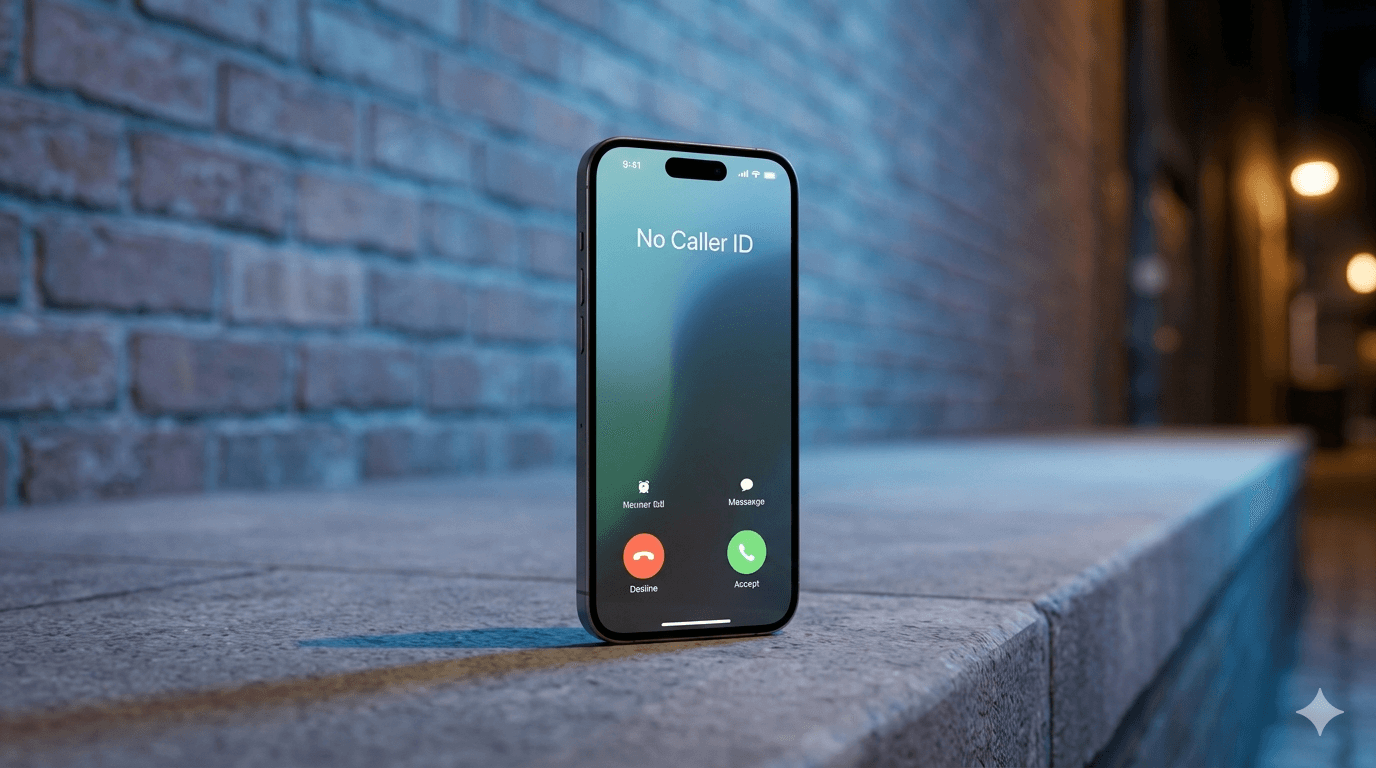
Things We'd Rather Do Than Answer an Unknown Call
When your phone lights up with "No Caller ID" or "Unknown Number," most people don't feel curious — they feel guarded. That split-second reaction has become one of the most universally shared experiences of modern life. Here's an honest breakdown of exactly what that avoidance looks like in practice.
1. Stare at the Phone and Debate It
It starts here. The phone rings, the screen offers nothing useful, and instead of answering, you watch it — as if sustained eye contact will somehow reveal who's on the other end.
This internal deliberation isn't dramatic. It's a rational response to a real problem. Over the past decade, answering the phone has shifted from a reflex to a calculated decision. Ynet (ynet.co.il), one of Israel's most widely read news platforms, has reported extensively on the rise of telephone fraud targeting Israeli residents through spoofed and anonymous numbers — which explains why even a momentary ring from an unknown source now triggers a full mental risk assessment.
2. Tackle That Task You've Been Delaying for Weeks
Sort through old photos. Clear out a cluttered closet. Research something you've been putting off indefinitely. An unknown call has a remarkable ability to make every other pending task feel suddenly urgent and worthwhile.
The underlying dynamic is cognitive: uncertainty is mentally taxing. When your phone rings without any identifying information, your brain is immediately forced to process a rapid sequence of questions — Is this important? Could this be a scam? Is someone intentionally hiding their number? That mental load is what people are genuinely avoiding, not the call itself.
3. Reorganize the Entire Email Inbox
Consider how neglected your inbox has to be before you voluntarily decide to sort it. And yet, when an unknown number calls, tackling thousands of unread emails somehow feels like the more appealing option. You'll build folders, unsubscribe from lists, and search old keywords just to feel a sense of order.
Email spam, for all its irritation, feels controllable. You can filter, delete, and block with predictable results. Phone fraud feels different — more intrusive, less manageable. The Israel National Cyber Directorate (מערך הסייבר הלאומי) has published consumer guidance specifically addressing phone-based fraud and social engineering attacks, underscoring that this isn't a minor or occasional problem.
4. Scroll Through Social Media — "Just Quickly"
It won't be quick. It will be closer to 25 minutes, and you'll resurface wondering where the time went. But even that feels less stressful than the ambiguity of picking up a call that offers zero context upfront.
What we're really avoiding isn't the conversation itself — it's the anxiety of not knowing what we're walking into. Globes (גלובס), Israel's leading business and financial news outlet, has covered the steady rise in phone scams targeting Israeli consumers, particularly those operating through hidden or manipulated numbers. Scrolling, at least, carries no hidden risk.
5. Voluntarily Call the Bank
This one says everything. Choosing to call your bank — hold music, automated menus, identity verification, the full experience — over answering an incoming unknown call is a clear signal of just how unappealing that anonymous ring feels.
And the discomfort is well-founded. Spoofed numbers are designed to appear familiar or even institutional on your screen. The Bank of Israel (בנק ישראל) has issued multiple public alerts warning consumers about phone impersonation scams in which callers fraudulently pose as bank representatives to extract financial or personal information. The hold music, in that context, is genuinely the better option.
6. Deep-Clean the Kitchen
Not a surface wipe. The full operation — behind the appliances, inside the miscellaneous drawer that somehow accumulated dead batteries and paperwork from three years ago, underneath everything that's been quietly ignored for months.
An unknown call rings and suddenly the kitchen feels like a priority. The reason is simple: cleaning has a visible, satisfying outcome. A mystery call does not. According to the Israel Consumer Council (מועצת הצרכנים), unsolicited and deceptive phone calls consistently rank among the most reported consumer complaints in Israel annually. At least when the kitchen is clean, you know exactly what you accomplished.
Why Unknown Calls Feel So Loaded Today
There was a time when picking up the phone was instinctive. Today, it requires a decision. That shift didn't happen arbitrarily — it's the direct result of the volume and sophistication of fraudulent calls that people now encounter on a regular basis.
Israel is no exception to this global pattern. Phone-based scams have grown more targeted and technically convincing, making it genuinely difficult to distinguish a legitimate call from a manipulative one purely based on a ringing screen.
The Core Problem: Absence of Information
The real reason people avoid unknown calls isn't avoidance for its own sake — it's the absence of any useful information. When you don't know who is calling, you can't assess what they want, whether it's urgent, or whether engaging is even safe. That gap between the ring and the answer is where the hesitation lives.
This is the exact problem that caller identification tools are built to solve. Traceback is an app developed specifically to identify unknown and no-caller-ID numbers, giving users the context they need before deciding whether to answer. Instead of staring at a ringing screen and running through worst-case scenarios, you simply see who it is. The uncertainty — and the avoidance it creates — disappears with it.
A Final, Practical Observation
If an unknown number calls you today, you might find yourself cleaning the kitchen, reorganizing your inbox, voluntarily contacting your bank, or disappearing into your social media feed. All of that is a completely understandable response to a problem that feels unsolvable in the moment.
But it is solvable. Clarity removes hesitation, and the tools to achieve that clarity already exist. For anyone who regularly encounters hidden numbers, the practical step isn't continued avoidance — it's simply having better information.